
Achieving more stable chrysanthemum quality through automated height measurements
Linflowers, a family business with a total of 22 hectares, cultivates chrysanthemums year-round for the high segment in Eastern Europe. Stable quality is essential for this segment. To guarantee and improve this quality, LinFlowers invested in AgriData Innovations' (ADI) camera system for automated height measurements.
The challenge: Anticipating too late
Before the implementation of ADI technology, height measurements were carried out manually, and only on the day the growers were going to apply retardants. This resulted, during certain periods of the year, in anticipating changes in height growth too late. While the rate of height development for specific plants could be monitored, a reliable picture of the average height per compartment was missing.
Reliable data drives the retardant strategy
ADI's camera system now provides reliable height determination. After some initial focus points regarding hardware and data input, the system is now stable. This is crucial, because "it is immensely important that you can rely 100% on the data you receive," according to Leendert van Tuijl, co-owner at Linflowers. Thanks to this confidence, the retardant application is now fully determined based on the measurements performed by the camera.
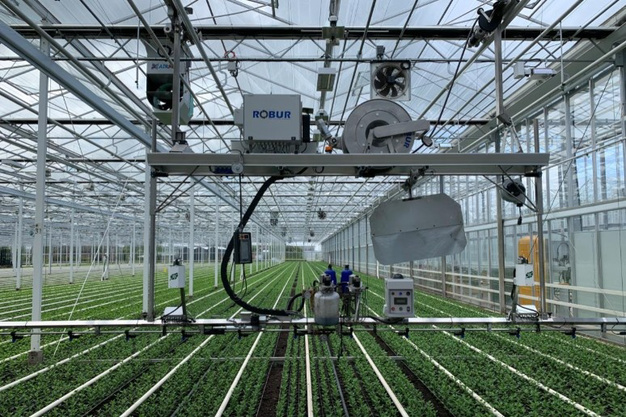
The integration into the workflow is done in combination with the automatic spraying robot. By combining the measurement moments with spraying as much as possible, the workflow is optimally utilized.
Remote control and insight
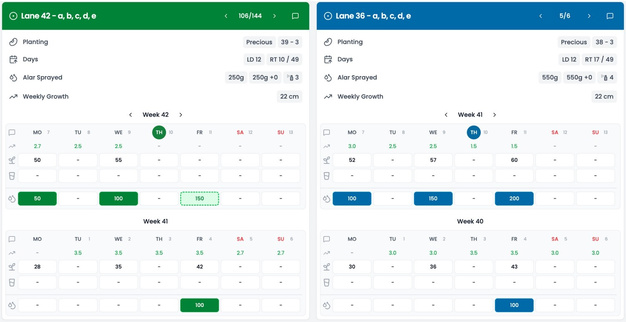
The Digitale Teeltronde (Digital Crop Walk) app plays a key role in daily operations. The grower views the camera's height measurements in the app and can use this to determine and schedule the retardant application. It is useful that the height development of a compartment, including a reference compartment (often one week earlier), can be seen at a glance.
This data-driven insight enables faster decision-making: "For example, you can now see at a glance that you are at 40 cm two days earlier this week than last week. This allows you to decide to adjust the retardant strategy earlier," says Leendert van Tuijl.
The reliable data has changed the approach to cultivation. Leendert van Tuijl notes that a lot can be done remotely with the help of reliable data: "For twenty weeks now, retardant decisions have been made exclusively based on this data, because I study two days a week, I don't see my crop every day. I've been determining my retardant solely based on this data for 20 weeks, and it turns out it's simply possible."
A stepping stone to data-driven cultivation
The system does not directly lead to labor savings but is seen as "a stepping stone to fully data-driven cultivation." The primary gain is in the achieved end product: the ability to react earlier to changing conditions has made the final height and branch structure even more stable.
For more information:

AgriData Innovations
Email: info@adinnovations.nl
www.agridatainnovations.nl
Linflowers
Email: info@linflowers.com

Publication date: Thu 4 Jun 2026


